 Dog Grooming Products
How to Lower Nitrates in a Marine Aquarium

Why Nitrates Are the Silent Threat in Every Marine Tank
Learning how to lower nitrates in a marine aquarium is one of the most important skills any reef keeper will develop. Nitrates build up silently over weeks and months. By the time you notice your corals retracting, your fish looking stressed, or nuisance algae spreading across the glass, nitrate levels have often been elevated for a long time. Understanding where nitrates come from and how to control them is the difference between a thriving reef and one that slowly declines.
In this guide you will find everything you need. We cover safe target levels for different tank types, seven proven methods to bring nitrates down, an emergency action plan for badly spiked tanks, and the most common mistakes that keep nitrates stubbornly high even after weeks of effort.
What Causes Nitrates to Rise in a Marine Tank
Nitrates are the final product of the nitrogen cycle. Fish waste, uneaten food, and decaying organic matter break down into ammonia, which beneficial bacteria convert to nitrite and then to nitrate. While ammonia and nitrite are acutely toxic, nitrate accumulates gradually. This slow accumulation is why many hobbyists do not realise the problem until real damage has occurred.
In addition, Indian marine tanks face specific challenges that accelerate nitrate production. Ambient temperatures in cities like Hyderabad, Chennai, and Mumbai regularly push tank water above 28 degrees Celsius during summer. Warmer water speeds up bacterial activity and organic decomposition, meaning nitrate is produced faster than in cooler setups. Furthermore, power cuts that stop protein skimmers and return pumps allow detritus to settle and break down rapidly, creating large nitrate spikes that can take weeks to reverse.
Safe Nitrate Levels for Your Marine Aquarium
Different tank types have very different nitrate tolerances. Therefore, knowing your target before you start correcting the problem is essential.
Fish Only Marine Tanks
Fish only tanks can tolerate nitrates up to around 40 parts per million without causing immediate harm to healthy, established fish. However, stress becomes visible above 30 parts per million in sensitive species, and newly added fish may suffer from shock even at these levels.
LPS and Soft Coral Reef Tanks
LPS corals and soft corals prefer nitrates below 10 to 20 parts per million. Above this level, many LPS corals retract their polyps, lose colour, and stop feeding properly. As a result, growth slows significantly even when all other parameters are correct.
SPS and Mixed Reef Tanks
SPS corals and clams require the cleanest possible water. Nitrates above 5 parts per million will noticeably affect SPS coral colour and skeleton growth. The ideal target for a serious SPS tank is between 1 and 5 parts per million, closely mirroring the natural seawater these animals evolved in.
To know exactly where your tank stands, test regularly using a reliable marine test kit. Testing at least once a week is the minimum when working to bring nitrates under control.
7 Proven Ways to Lower Nitrates in a Marine Aquarium
1. Regular Water Changes Done the Right Way
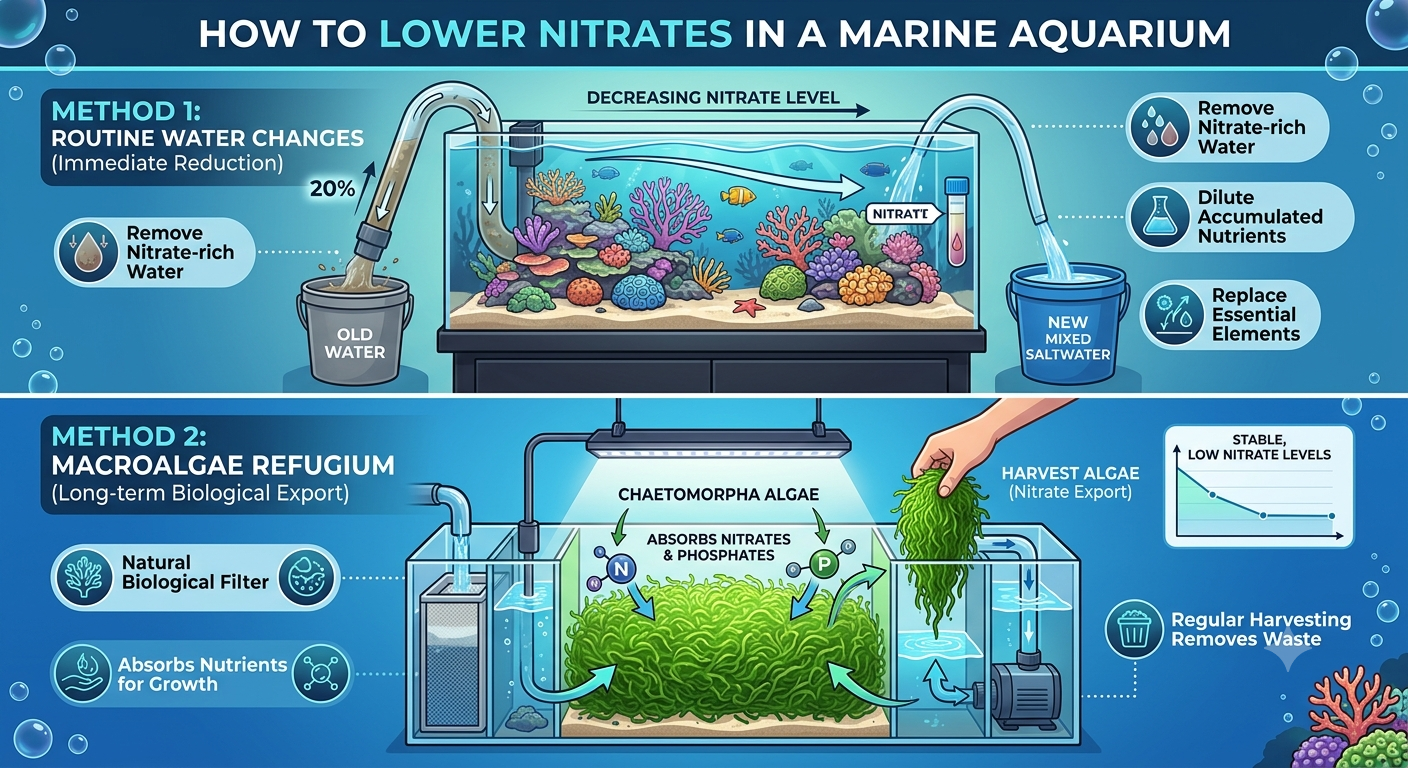
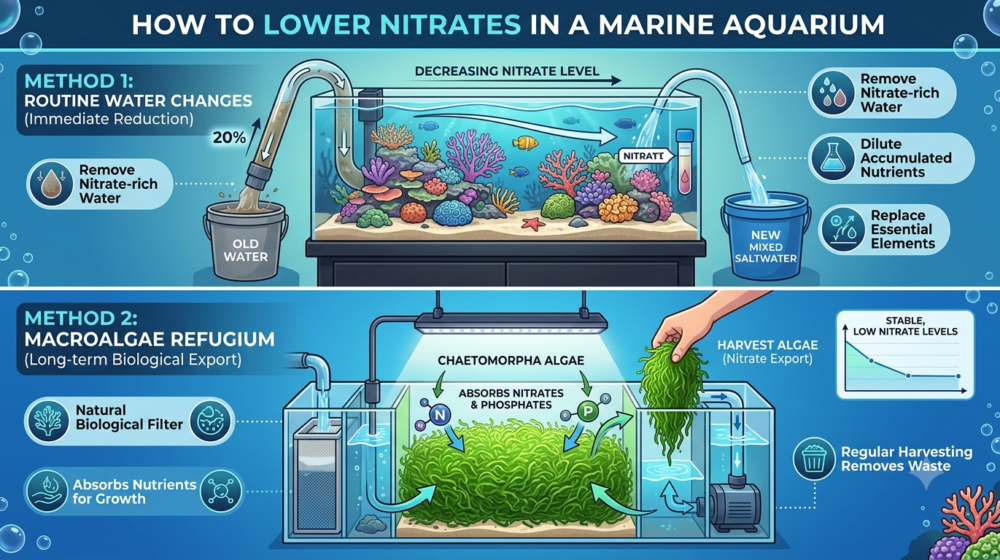
Water changes remain the simplest and most reliable tool for lowering nitrates. However, the method matters just as much as the frequency. A 10 to 15 percent water change every week using nitrate-free premium marine salt will dilute nitrate levels steadily over time.
For tanks with very high nitrates above 80 parts per million, performing a single large water change is not recommended. The sudden shift in water chemistry can shock corals and fish. Instead, perform three separate 20 percent changes over three consecutive days. This approach brings nitrate down safely without stressing your inhabitants. Always use a quality marine aquarium salt that is certified free from nitrates and phosphates to ensure each water change starts from a clean baseline.
2. Optimise Your Protein Skimmer
A protein skimmer removes dissolved organic compounds from the water before they have any chance to break down into ammonia and eventually nitrate. Therefore, a properly tuned skimmer significantly reduces the nitrate load before it even forms in the first place. If your skimmer is not producing at least a full cup of dark, thick skimmate every week, it is either undersized for your tank volume or needs a thorough cleaning.
Upgrading to a larger, more efficient skimmer is one of the best long-term investments you can make for nitrate control. Browse the full range of protein skimmers available at Ocean Paws to find the right model for your system.
3. Use Biological Denitrification Media
Biological denitrification media contains millions of tiny pores that house anaerobic bacteria. These bacteria operate in oxygen-depleted zones and convert nitrate directly into harmless nitrogen gas, which then escapes from the water. This is fundamentally different from standard aerobic biological filtration, which only converts ammonia to nitrate without ever removing it.
The Maxspect Nano Tech Anaerobic Block is specifically engineered for this purpose. Its highly porous ceramic structure creates the oxygen-free zones that denitrifying bacteria require. It works passively inside your sump or filter compartment with no need for a separate reactor, making it one of the most practical nitrate reduction tools available to Indian reef keepers. Many hobbyists see nitrate reductions of 30 to 50 percent within four to six weeks of adding this media to an established system. Explore additional marine filter media options to complement your overall filtration approach.
4. Add a Refugium with Macroalgae
A refugium is a separate compartment, typically built into the sump, where macroalgae such as Chaetomorpha is grown under a dedicated grow light. Chaeto absorbs nitrate and phosphate directly from the water as it grows. When you harvest and remove portions of the algae mass, you are physically exporting those dissolved nutrients out of your system permanently.
A refugium works particularly well in Indian marine setups because warm ambient temperatures promote very rapid Chaeto growth, turning a potential disadvantage into a powerful nutrient export engine. Additionally, the refugium provides a sheltered environment for copepods and other microfauna that enrich the biodiversity of your tank.
5. Dose NP Reducing Bacteria
Carbon dosing feeds anaerobic bacteria with a carbon source so they can multiply rapidly and consume both nitrate and phosphate. Commercial reef probiotic products make this process safe and controllable. Aquaforest NP Pro is a reef probiotic medium that supports beneficial bacterial growth and systematically reduces nitrate and phosphate levels without the unpredictability or risk of DIY dosing with vodka or vinegar. It works especially well when paired with a protein skimmer that is running at full capacity, as the skimmer removes the excess bacterial biomass that NP Pro generates.
6. Reduce Bioload and Feeding
No amount of filtration equipment will keep pace with a chronically overstocked or overfed tank. Consequently, every extra fish and every extra pinch of food that goes uneaten adds to the ammonia load that ultimately becomes nitrate. Reviewing your stocking and feeding habits is therefore essential before investing in more equipment.
Feed small amounts that your fish consume completely within two minutes. Remove any uneaten food immediately using a turkey baster or small net. In addition, siphon detritus from sandbed corners and sump compartments during every water change, as settled detritus is a highly concentrated source of nitrogen loading that many hobbyists overlook.
7. Clean Mechanical Filtration Regularly
Filter socks, filter wool, and sponge media trap organic particles before they dissolve and produce nitrate. However, if these materials are not cleaned or replaced frequently, they become the very source of nitrate they were intended to prevent. Filter socks should be cleaned every two to three days. Filter wool should be replaced weekly. This single maintenance habit can produce a significant reduction in nitrate input for tanks with a moderate to high bioload.
Emergency Action Plan for Severely High Nitrates
If your marine aquarium nitrate test reads above 80 parts per million, follow this phased approach rather than making large sudden changes that could stress your livestock.
Day 1 to Day 3
Perform three separate 20 percent water changes using fresh nitrate-free saltwater. Do not exceed 20 percent in any single session. Clean or replace all mechanical filtration media at the same time to remove accumulated detritus.
Day 4 to Day 7
Add biological denitrification media to your sump if not already in use. Begin dosing NP reducing bacteria at the lowest recommended starting dose. Test nitrates daily during this phase to track the direction of progress.
Week 2 Onward
Continue weekly 15 percent water changes. Calibrate your protein skimmer for maximum sustained output. Review and reduce your stocking and feeding. Consider adding a refugium if your sump has available space. Continue testing nitrates weekly to confirm the downward trend is holding.
Common Mistakes That Keep Nitrates High
Even experienced reef keepers fall into habits that silently undermine their nitrate reduction efforts. Therefore, understanding these traps is as important as knowing the solutions themselves.
Relying on Water Changes Alone
Water changes dilute existing nitrate but do not address the source that is continuously producing it. Without reducing input, nitrate will return to the same level within days of each change. Combining water changes with at least one of the denitrification methods above is essential for lasting results.
Neglecting Mechanical Filtration Maintenance
A filter sock left unchanged for a week becomes a nitrate factory. Many hobbyists invest in expensive dosing equipment but overlook the need to clean the most basic mechanical filtration. Consequently, their nitrate remains high regardless of their other efforts.
Testing Too Infrequently
Nitrate problems caught early are straightforward to correct. Problems discovered when corals are already bleaching and receding are far more difficult and expensive to reverse. Test your marine water parameters at minimum once a week as part of your standard maintenance routine.
How Long Does It Take to Lower Nitrates
The timeline depends on how elevated your starting nitrate level is and which combination of methods you deploy. With consistent 15 percent weekly water changes alone, expect to see a 30 to 40 percent reduction within three to four weeks. Adding biological denitrification media accelerates this further, with most tanks showing measurable improvement within four to six weeks.
Carbon dosing with a product like Aquaforest NP Pro, combined with a well-tuned protein skimmer, can bring nitrates below 10 parts per million in two to four weeks in moderately stocked tanks. Patience and consistency are more important than any single product or piece of equipment.
Build a Stable Marine System from the Start
Lowering nitrates in a marine aquarium is not about finding one perfect solution. It is about combining several complementary methods and remaining consistent with your maintenance schedule. Start with correct water changes and mechanical filtration maintenance, then add biological tools such as denitrification media and NP reducing bacteria to address the root causes.
If you are setting up a new marine tank and want to avoid nitrate problems from the beginning, read our complete guide on how to set up a marine aquarium for a step by step approach to building a stable, thriving system from the ground up.


